


Subway Tile Layouts: From Classic to Modern Designs
 Nura
Nura
Traditional subway tile patterns are reliable classics, but many homeowners would like something different, or more modern. Thankfully, the main reason behind the popularity of this tile is its immense versatility, and there are various different subway tile layouts you can try that will suit your space and your style.
From Classic to Creative: Subway Tile Layout Ideas
Transform basic subway tile styles into something fresh and stylish with these layout ideas:
The Original Classic Running Bond


Running bond is a classic for a reason - it looks good anywhere you install it, and it works with any subway tile size or format. Where other subway tile layouts can be too complicated, or just the wrong fit for the tile format, running bond is a great base, particularly when you’ve got a big area to fill or when your tile has a special characteristic, like a bold color, an interesting pattern, or an unusual texture or finish.
Subtle Variations of Running Bond For A Modern Twist


If you want something a bit more interesting, but that still retains the general spirit of traditional running bond, have you considered a vertical running bond subway tile layout? Still classic, and super easy to pair with any kind of tile, but just a little bit more visually stimulating. Plus, any kind of vertical layout draws the eye upward, which, in turn, helps the space look taller. It’s the base for great subway tile designs for showers.
The Vertical Stack Layout


For a more modern approach, vertical stack subway tile layout is your ideal option. Exceptionally crisp and precise, it creates inherent structure in a space that, perhaps, needs this type of grounding element. It works best with a tile that has some sort of gloss or sheen, or when the grout is different enough in color to allow the grid-like pattern of the tile to shine on its own accord. It’s a feature in itself, one that’s particularly suitable for a modernist, slightly deco design sensibility.
The Herringbone Pattern


While it originally emerged as a modern variation of one of the classic subway tile layouts, herringbone has quickly become a modern classic beloved by homeowners and used in almost any space. It’s interesting enough to give it some depth, but not overly complex, as to take over all the attention. You’ll notice that most subway tile backsplash patterns over the past couple of years are variations of herringbone.
The Chevron Pattern


Very similar to herringbone, but slightly more restrained, chevron makes an excellent statement layout among subway tile patterns for showers & and bathrooms, particularly. It creates a sense of verticality and also draws major attention with the V-shaped placement, like a feature wall. One of the best subway tile shower patterns, especially when you’re trying to create a visually distinct area for a walk-in shower.
The Basketweave Layout


Basketweave (and its sister variant, double basketweave) is a fun way to create a visually distinct layout without adding a second tile in a different size, color, or finish. You can easily create a special subway tile pattern in order to inject some interest into an otherwise neutral, or inoffensive tile choice. If you want to get even more complex, basketweave is the perfect opportunity to experiment with 2 color subway tile patterns.
The Stacked Grid Look


Another fresh approach to a subway tile layout is a horizontal stack, or stacked grid. Very similar to vertical stack, the horizontal stack is closer in look to a traditional subway tile brick pattern, but it’s more meticulously placed, with the tiles carefully ordered. It’s a great option for a subway tile pattern backsplash because it fits so well in that space under the kitchen cabinets.
Mixing Layouts Within the Same Space
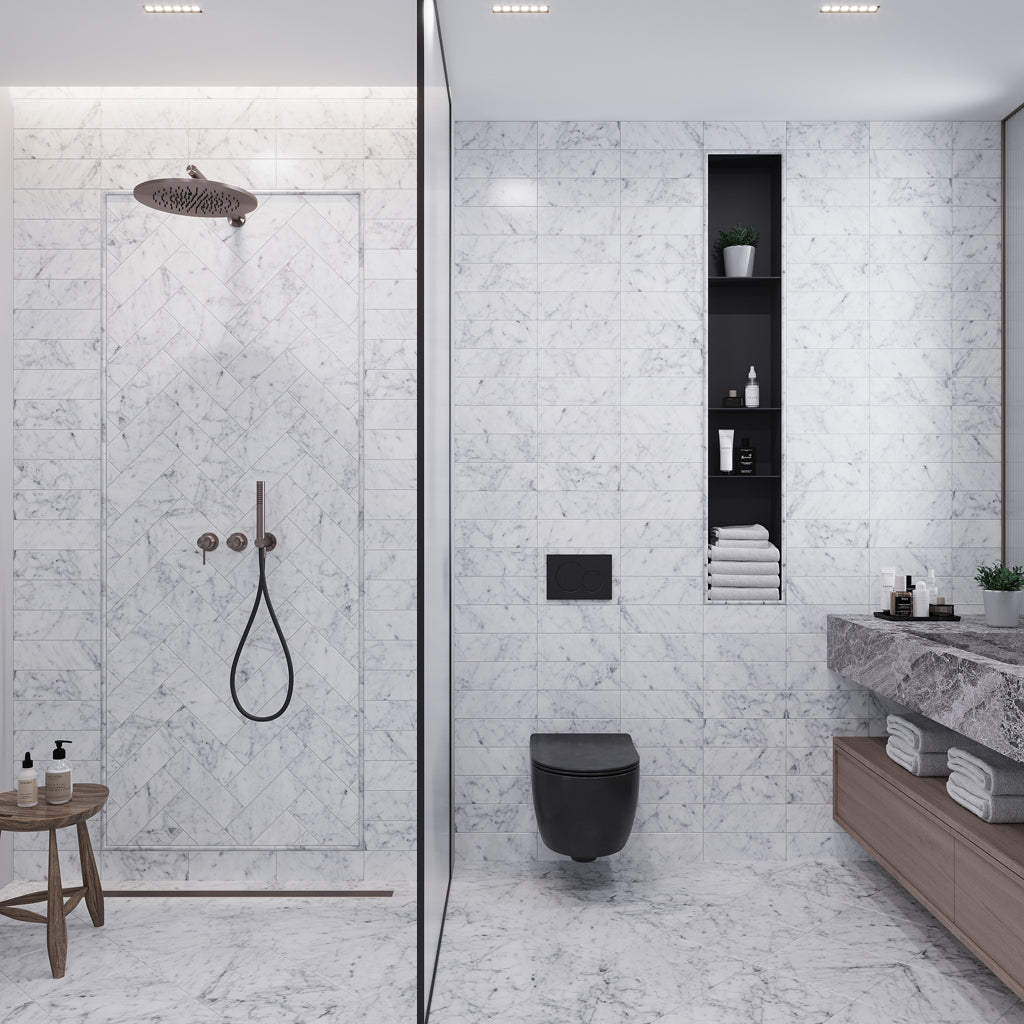

There are two approaches to a modern mixed layout design: either you make it a very bold, contrasting design choice, where the visual pairing is the main feature element of the space (a great candidate for subway tile patterns with two colors), or you go subtle with it and allow it to quietly define and separate different areas of the same space. You can use a horizontal stack with a subway tile herringbone pattern or another visually dense design.
Choosing the Right Subway Tile Layout Based on Space, Scale, and Lighting


While subway tile is an excellent choice for any space, depending on the room, the tile choice, and the lighting, you may choose different kinds of modern subway tile patterns. Let’s look at a few scenarios and what the ideal subway tile layout ideas might be:
My bathroom is small, but it gets great natural light.
Take advantage of that gorgeous light, and opt for a tile in a glossy finish and a light color in a vertical stack layout. That’s going to make the space appear bigger, both because it reflects light and because the vertical stack helps the room seem taller.
I have a large kitchen and it feels too sterile.
A larger space can carry a more complicated design and more grout lines. You have the freedom to play with either a more visually complex design, such as a herringbone, or you can even mix subway tile layouts, and create a basketweave focal point on a simple wall. That achieves two things: it helps fill and break up the space and it gives it some personality. You can also opt for a large format matte tile for subway tile floor patterns. A dark color, like gray, is suitable in a large space that is likely to get stained or see high traffic, like the kitchen.
I want a feature wall for my dark, narrow hallway.
This space needs something exciting to bring out some sparkle from the darkness. A horizontal stack works great here, or even one of the classic subway tile patterns, like running bond, in a mirrored finish. The reflective quality of the polished tile is a big statement, that is best paired with a very clean, simple layout. You want the finish to be the main event.
I have a high ceiling, high traffic living room with a large fireplace.
Another space where a large format floor tile fits in perfectly. It’s not just easy to clean, but it can look very high-end and elevate the space greatly. As for the fireplace, this is a great opportunity to create a chevron pattern with subway tile. The choice is yours in terms of color, finish, and pattern, but a tile with a slick texture or an unexpected color (are you adventurous enough for 3 color subway tile patterns?) can do wonders for this design element.
How to Choose a Layout That Matches Your Design Style
Thankfully, subway tile layouts are versatile enough that they’re usually pretty applicable to all interior design styles, but there are things to think about, depending on your preferences.
For a minimalist style, you can opt for bold color, complemented by a very geometric layout, like vertical stack. That puts the focus squarely on the strong shade, and it keeps it from feeling chaotic or overwhelming in the space. You probably also want to opt for a matte tile.
Maximalist design is more playful. If you’re into clashing unique subway tile layout patterns and busy design, then you might even want to try to mix layouts, like a basketweave together with a running bond. It can be difficult to estimate how much tile you need, but we offer a subway tile layout planner for all tile options where you can calculate how much you need for your surface.
Frequently Asked Questions
1. Are subway tile wall patterns still trending?
2. What is the most popular subway tile pattern?
3. What are the pros & cons of subway tile?
4. What is the best subway tile size for backsplashes?
5. What is the most popular subway tile color?

Nura
Nura has always been drawn to design and the way our eyes and senses experience a space. She’s fascinated by the stories that interiors and architecture quietly tell. Traveling across countries and seeing architecture in its natural setting helped her notice how materials, patterns, and textures quietly shape emotion and personality in a space.
Before joining Tiletopia, Nura spent over a decade in brand management, market research, and consumer behavior across different industries, working in brand storytelling and crafting content that brings ideas to life. At the intersection of storytelling and design, Nura has found her creative home at Tiletopia, where she brings both passions to life.
Share This Post
Enjoyed this article? Share it with someone who’ll love it too.